Gadget Man Dots Logo

SJCAM SJ30: The Action Camera That’s Finally Built for Everyday Life

There’s a certain expectation that comes with action cameras. Snowboards, skydives, mountain bikes flying down impossible trails… you get the idea. But what if most people just want to capture life?

That’s exactly where the new SJCAM SJ30 steps in, and it’s a rather interesting shift in thinking.

Not Just for the Extreme Crowd

Rather than chasing the usual “extreme sports” narrative, SJCAM has positioned the SJ30 as a daily recording camera. That means something a bit more relatable. Commutes. Family days out. Travel. Those spontaneous moments that don’t come with a helmet cam and a GoPro mount.

It’s a subtle but important repositioning, and one that makes a lot of sense.

According to the launch material, the SJ30 is designed to prioritise what most people actually care about: image quality, audio clarity, battery life, low-light performance, and simplicity.

Dual Lenses, One Clear Goal

At the heart of the SJ30 is a dual-lens system that pairs a daylight sensor with a dedicated starlight sensor. The idea here is straightforward. Consistent performance whether you’re filming in bright sunshine or capturing a city scene at night.

That second sensor is doing the heavy lifting in low light, an area where action cameras have traditionally struggled.

And yes, it does tick the resolution box too, supporting up to 8K video at 20fps and 4K at 60fps.

Designed for the Way People Actually Shoot

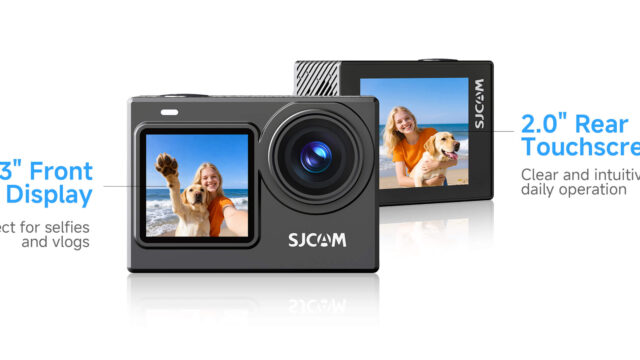
One of the more practical touches is the 2.51-inch flip touchscreen, which rotates 180 degrees. In other words, it’s built with solo creators in mind. No guesswork framing, no awkward angles.

Add in voice control, and you’ve got something that leans heavily into hands-free use. Ideal if you’re travelling, cycling, or just juggling too many things at once.

There’s also native vertical video support up to 5K, which means content can be captured as intended for social platforms, rather than cropped afterwards.

Keeping Things Steady

Stabilisation is handled by what SJCAM calls SteadyMotion 2.0, backed by a six-axis gyroscope. In simple terms, it’s there to smooth things out when life gets a bit… bumpy.

A built-in 45-degree horizon lock helps keep footage level too, even when the camera isn’t.

Built to Keep Going

Battery life is another area where the SJ30 leans into real-world use. With a 2000mAh internal battery and optional power handle, it can deliver up to seven hours of continuous recording at 4K.

That’s less “quick clips” and more “just leave it running and capture everything.”

Audio, Mounting and Practical Touches

Sound hasn’t been overlooked either. A detachable wind guard and support for a wireless microphone aim to improve audio quality in outdoor or high-motion environments.

There’s also a magnetic quick-release mounting system, which feels like one of those small but genuinely useful features. No fiddling about when you want to switch setups.

Ready for Real Conditions

Despite its everyday focus, the SJ30 hasn’t forgotten its action camera roots. It’s waterproof to 5 metres straight out of the box, or up to 30 metres with an optional case, and designed to operate in temperatures ranging from -20°C to 60°C.

So yes, it’ll still handle the more adventurous moments if they come along.

A Different Take on the Category

What stands out here isn’t just the spec sheet. It’s the intent.

The SJ30 isn’t trying to outdo every other action camera on extreme performance alone. Instead, it’s redefining what an action camera is for.

Less adrenaline. More everyday storytelling.

And perhaps that’s exactly what the category has been missing.

Price & Availability
The SJ30 is available now, priced at around £195.

SAYPH: The Smartphone That Isn’t Trying to Be Everything

There’s a quiet shift happening in the world of tech. For years, smartphones have been on a relentless march toward doing more, showing more, and demanding more of our attention. Now, a UK startup called Sayph is heading in the opposite direction… and it’s rather refreshing.

Sayph has unveiled what it describes as the UK’s first responsible smartphone for children aged 8 to 16. Not a cut-down adult device. Not a standard handset wrapped in layers of parental controls. Instead, this is something altogether different, a phone designed from the ground up with a very specific purpose in mind.

A Middle Ground That Actually Exists

For many parents, the decision is a familiar dilemma. No phone at all, or a fully fledged smartphone with all the baggage that comes with it. Social media, open internet access, endless notifications… it’s a lot.

Sayph positions itself squarely in the middle.

Out of the box, the device focuses on the essentials. Calls, one-to-one messaging, and location tracking. That’s it. No social media apps. No app store. No web browser unless a parent explicitly decides to enable it.

This isn’t about locking things down after the fact. It’s about starting from a place of simplicity and control.

Built Different, Not Bolted On

What makes this interesting is the philosophy behind it. Most devices rely on add-ons and restrictions layered over a standard smartphone experience. Sayph flips that approach completely.

Everything is intentional.

Contacts must be approved. Communication is controlled. And instead of navigating endless menus and toggles, parents use a companion web app designed to give clear oversight without turning into a full-time job.

It’s less about surveillance, more about structure.

Independence Without the Noise

Co-founder Ben Humphrey sums it up neatly, describing the challenge many families face today: giving children independence without exposing them to the pressures of always-on digital life.

Walking to school. Visiting friends. Staying in touch. These are the real-world use cases Sayph is built around.

Not scrolling. Not chasing likes. Not being pulled into the endless gravity of online platforms.

Fellow co-founder Ami Penolver frames it slightly differently, positioning the device as pro-childhood rather than anti-technology. It’s a subtle but important distinction, and one that feels increasingly relevant.

Pricing and Positioning

At £189 for the handset and £5 per month for the parental platform, Sayph is clearly aiming to sit in an accessible space. Not a premium luxury device, but not a disposable gadget either.

It’s a considered purchase. One that reflects a shift in thinking about what a child’s first phone should actually be.

Tech With a Social Angle

There’s also an interesting layer beyond the hardware itself. Sayph has built a social impact model into its rollout.

For every ten devices purchased within a school, one is donated to a pupil premium child. For every hundred devices sold overall, another is provided to a looked-after child.

It’s a small touch, but one that hints at a broader ambition. Not just selling devices, but shaping how children access technology in the first place.

There’s something quite compelling about a product that deliberately does less. In a market obsessed with features, specs and endless capability, Sayph feels like a bit of a reset button.

A phone that knows exactly what it’s for… and more importantly, what it isn’t.

And in today’s world, that might just be its biggest feature.

Available now at Sayph

Anthropic’s Project Glasswing Could Change Cybersecurity Forever

There are moments in tech when you read an announcement and immediately realise that something important has shifted.

That was very much my reaction when I came across Project Glasswing, a newly announced initiative from Anthropic that is aimed squarely at one of the biggest looming problems in modern computing: what happens when AI becomes exceptionally good at finding software vulnerabilities. Source

According to Anthropic, Project Glasswing brings together a heavyweight list of partners including Amazon Web Services, Apple, Broadcom, Cisco, CrowdStrike, Google, JPMorganChase, the Linux Foundation, Microsoft, NVIDIA and Palo Alto Networks, all with the goal of securing critical software for what Anthropic calls the AI era. It is also extending access to more than 40 additional organisations that build or maintain important software infrastructure. Source

Now, that alone would be interesting enough, but the real headline here is the model sitting behind it all.

Anthropic says its unreleased model, Claude Mythos Preview, has already demonstrated the ability to find and exploit software vulnerabilities at a level beyond all but the most skilled human experts. That is a huge claim, and if it holds up in practice, it means we may have crossed into a very different phase of cybersecurity. Source

In plain English, this is not just about a chatbot helping someone write a bit of code more quickly. This is about AI being able to inspect complex software, spot weaknesses that humans and automated tools have missed for years, and in some cases work out how those weaknesses could be exploited. Anthropic says the model has already found thousands of high-severity vulnerabilities, including flaws affecting major operating systems and web browsers. Source

Some of the examples are rather startling. Anthropic says Mythos Preview uncovered a 27-year-old vulnerability in OpenBSD, a 16-year-old flaw in FFmpeg, and even chained together several Linux kernel vulnerabilities in a way that could escalate ordinary user access into full control of a machine. The company says those issues have now been responsibly disclosed and patched. Source

That, to me, is the bit that really lands.

Because for years we have tended to think of cybersecurity in terms of patching known issues, following best practice, keeping software up to date and hoping the really serious flaws are found by the good people before the bad people. But if AI systems are now reaching the point where they can autonomously discover dangerous bugs in code that has survived decades of scrutiny, then the pace of both defence and attack could increase dramatically. Source

Anthropic is clearly trying to frame Glasswing as a defensive first move. The company says it is committing up to $100 million in usage credits for Mythos Preview and $4 million in direct donations to open-source security organisations. The idea seems to be to put these capabilities into the hands of defenders, infrastructure operators and maintainers before similar systems become more widely available. Source

And that is probably the most sensible angle here.

Because whether we like it or not, the genie is not going back in the bottle. If one frontier AI lab can build a model that is frighteningly good at vulnerability discovery, others will too. Eventually, those capabilities will spread further. The question is not really whether AI will reshape cybersecurity. It is whether defenders can get enough of a head start to stop things getting seriously messy. That is an inference from Anthropic’s announcement and the examples it gives, rather than a direct claim from the company, but it feels like the unavoidable conclusion. Source

For those of us who run websites, servers, ecommerce platforms, mail systems or anything else connected to the wider internet, this should be a bit of a wake-up call. The old approach of leaving systems half-maintained, delaying updates, or assuming that obscure software will somehow stay below the radar looks even more risky in a world where AI can inspect code at speed and scale.

Project Glasswing may turn out to be remembered as one of those early milestone moments, the point where the cybersecurity industry publicly acknowledged that AI is no longer just a helpful assistant for defenders. It is becoming a serious force multiplier, and one that could work for either side.

That makes this announcement both exciting and slightly chilling.

And, in true Gadget Man fashion, it is exactly the kind of development that reminds us technology is never just about shiny new tools. It is also about consequences, responsibility and how quickly the world has to adapt when the rules suddenly change.

Source

Anthropic, Project Glasswing: Securing critical software for the AI era

VIZO Steps Into the AR Arena with Cinema-Scale Smart Glasses

There is a quiet but unmistakable shift happening in wearable tech. What once felt like science fiction is edging closer to something you might genuinely throw in your bag alongside your phone and headphones. Enter the VIZO V1 AR Glasses, a new entrant aiming to make augmented reality feel less like a novelty and more like an everyday companion.

Backed by audio and hardware specialist TOZO, VIZO is positioning its debut product as a practical, usable piece of kit rather than a futuristic curiosity. And on paper, it makes a strong first impression.

A Pocket Cinema You Can Wear

VIZO Steps Into the AR Arena with Cinema-Scale Smart Glasses

The headline feature here is the 118 inch virtual display, effectively turning the glasses into a personal cinema screen. Pair that with Full HD resolution, a 41 degree field of view, and a claimed 100,000 to 1 contrast ratio, and you are looking at something designed squarely for media consumption.

What makes it more interesting is the 1800 nit brightness, which is unusually high for this category. That matters because one of the long standing weaknesses of wearable displays has been usability outside dimly lit rooms. VIZO is clearly pushing the idea that this is something you can use on a train, in a park, or sat by a bright window without everything washing out.

Designed for Real Life, Not Just Demos

One of the biggest hurdles for AR glasses has always been comfort. If they are awkward or fatiguing, they simply do not get used.

VIZO claims to have leaned heavily into real world testing here, producing a lightweight and balanced design intended for longer sessions. There is also built in myopia adjustment up to 500 degrees, which is a genuinely practical touch. It means a chunk of users can skip prescription inserts altogether and just dial things in.

That sort of thinking suggests this is less about impressing at a trade show and more about surviving daily use.

Plug, Play, and Get On With It

VIZO Steps Into the AR Arena with Cinema-Scale Smart Glasses

Connectivity is refreshingly straightforward. The V1 uses USB C with DisplayPort support, meaning it should work with a wide range of devices including smartphones, laptops, and even games consoles.

No convoluted pairing process. No ecosystem lock in. Just plug it in and go.

That simplicity could be one of its biggest strengths, especially for anyone who has wrestled with early VR or AR setups that felt like assembling a small satellite before you could watch a film.

More Than Just a Screen

Audio is handled via integrated stereo speakers, and there is support for switching between 2D and 3D viewing modes. That points towards a flexible use case, from streaming films to casual gaming or even just expanding your screen real estate when working on the move.

It is not trying to be a full mixed reality headset. Instead, it sits in an interesting middle ground between entertainment device and productivity tool.

VIZO Steps Into the AR Arena with Cinema-Scale Smart Glasses

A New Name to Watch?

VIZO itself is a relatively new brand, founded in 2025 and built around the idea of “Tech Around You.” That philosophy comes through quite clearly here. The V1 does not attempt to reinvent computing, but rather slips into your existing setup and enhances it.

Whether it succeeds will depend on real world adoption, but the direction is promising. AR does not need to be dramatic to be useful. Sometimes it just needs to work.

The VIZO V1 is available now via TOZO’s store and Amazon UK, signalling a fairly confident launch rather than a tentative experiment.

Final Thoughts

We have seen plenty of ambitious AR concepts over the years. Many have dazzled briefly before fading away under the weight of complexity or impracticality.

What makes the VIZO V1 interesting is that it appears to be aiming for something far simpler. A wearable screen that just works, wherever you happen to be.

And in 2026, that might be exactly what this space needs.

VIZO V1 AR Glasses Available from Amazon for around £399

Tyre Problems That Should Never Be Ignored

Your tyres are your car’s only point of contact with the road. Your tyres need to be fit for purpose at all times, and regular checks should be carried out to ensure that’s always the case.

It’s more than just checking a tyre that is correctly inflated — you can find this information online or in your manufacturer’s handbook if you’re unsure.

It’s about making sure you understand what tyres in good condition look like, and you know the warning signs of tyres that need repairs or recycling, because driving on unsuitable tyres is a recipe for disaster. At the very least, you’ll find yourself unable to drive with a deflated tyre. At worst, it can cause an accident and result in fines, a criminal record, a jail sentence and loss of life. It’s really not worth the risk.

So let’s take a look at some of the more common tyre problems you definitely shouldn’t ignore.

Tyre Pressure Loss

Tyres will, over time, deflate slightly, but if you’re noticing you’re needing to fill them with air more frequently, or you’re coming out to go to work in the morning, and you have a flat tyre despite having only just inflated them you have a slow puncture somewhere that’s allowing the air to escape.

Sometimes this happens over the course of a day or overnight; other times it’s slower over a few days. But if you’re noticing you have flat tyres frequently its time to get them checked

Some tyres can benefit from a puncture repair if they’re still in otherwise good condition and above legal tread limits. Especially if the offending object hasn’t damaged the tyre when it creates the puncture.

You can check yourself for the puncture, but it’s best to get it fixed by a proper technician, and for the most part, you can find same day mobile tyre fitting services to get you back on the road wherever you are.

Visible Punctures

There’s a difference between slow punctures and noticing debris in your tyre. If you see anything sticking out, be it a bit of metal, glass, nail, or anything, do not drive. Get your tyre replaced immediately. If you have breakdown cover when you spot a puncture, you might be able to use the services to get your tyre changed if you’re not at home or you’ve been driving on it.

Of course, you can change the tyre yourself if you’re able to too. But if you notice any visible damage or something in your tyres that shouldn’t be there, i.e. anything don’t drive, get it sorted, and remember to replace your spare tyre if you put it on, so you have back up if it happens again.

Sidewall Bulges

Sidewall bulges can happen anywhere on the tyre and are extremely dangerous to drive on. The bulge is caused by an increase in air pressure inside the tyre resulting from structural damage. It’s a sign the internal chords have broken, and the tyre is not fit for road use. And this can be down to hitting one too many potholes at speed, a defect in the tyre or climbing kerbs, for example.

Even if you can’t see the bulge in your tyre, you’ll feel it when you’re driving, your car will feel like it’s rolling over small bumps constantly and feel unstable to drive.

Sadly, there’s no fix for this type of damage, and the only solution is to get a completely new tyre. And when you do, make sure to check the wheel itself for any damage to make sure it’s just the tyre. If it’s not, then you need to get wheel repairs carried out before fitting a new tyre.

Uneven Tyre Wear

Your tyres should wear evenly; that goes without saying. But what they should do and what they actually do, don’t always go hand in hand, and different driving conditions can impact how your tyres wear when you’re driving.

If your tracking is out or your wheels aren’t balanced correctly, then you might find that your tyres wear out on one side more than the other, and this reduces grip on the road in both dry and wet conditions, and if you frequently travel at speed, then this is a recipe for disaster. But what if your tyres are wearing in the centre? This is likely due to overinflation and wear on both the outsides, whichis dirign with with underinflated tyres.

Continuing to drive with tyres in this condition puts you at risk of a fine if you’re caught by the police, increases stopping distances and increases the risk of accidents.

The key here is to get your tyres replaced and the alignment issues sorted at the same time, or check the right tyre pressure for your car so you don’t inflate them incorrectly.

Loss of Grip on Wet Roads

If it feels like you’re not as stable when driving in wet weather, or it’s taking you longer to stop when it’s raining, this is almost always a tyre issue. Again, they’re your point of contact with the road, and if they’re not in good condition, you’ll notice this all a lot more when driving in the rain.

And it’s down to low tread. You need to have at least 1.6mm of tread depth across the central portion of the tyre, but wet grip performance is lost well before you get to this limit.

You can check your tyre grip by using a 20p coin. The tread should cover the outer rim edge of the coin. If it doesn’t, it’s too shallow and you need new tyres as a matter of urgency.

Leaving tyre issues in the hope they’re “not that bad” or that they’re not impacting your driving is risky. Poor tyre condition leads to accidents and can land you in legal trouble, as your car needs to be roadworthy at all times.

Always check your tyres regularly for the correct level of inflation for invisible damage to any objects being stuck in the tyre or bulges on any part of the wheel. For the most part, visual checks will suffice, but take the time to physically touch it and have a more thorough check, so you’re not missing anything.

AWS, Middle East Escalation and a Very Real Reminder That the Internet Is Physical

Over the weekend something unusual happened.

The AWS Health Dashboard lit up with warnings across the Middle East regions, while at the very same time global news outlets were reporting escalating military action across the Gulf.

If you run infrastructure in the cloud, or even if you just assume “the cloud” is always there, this was a sobering moment.

Let’s unpack what actually happened.


What Amazon Web Services Said

According to the official AWS Service Health Dashboard:

“Objects struck the data centre, creating sparks and fire.”

That is not typical outage language.

AWS reported that two Availability Zones in the ME-CENTRAL-1 region were impaired due to a localized power issue. Power was shut off while emergency services responded, and recovery would require:

  • Repair of facilities
  • Restoration of cooling systems
  • Restoration of power systems
  • Coordination with local authorities
  • Safety assessments before re-energising the site

Customers were strongly advised to fail over to alternate regions, ideally in Europe.

This was not a minor API hiccup. EC2, S3, DynamoDB, the AWS Management Console and dozens of other services experienced elevated error rates.

The cloud, quite literally, caught fire.

Source: AWS Service Health Dashboard


At The Same Time… The World Was On Edge

Simultaneously, live coverage from BBC News reported dramatic escalation in the region:

  • Iranian strikes on a major gas plant in Qatar
  • A refinery fire in Saudi Arabia
  • Drones intercepted over Cyprus heading towards a UK base
  • Escalating conflict involving Israel, Lebanon and Iran
  • Reports that Iran’s Supreme Leader had been killed in US and Israeli strikes

Gas prices reportedly spiked sharply on international markets.

Source: BBC Live Coverage

AWS has not explicitly linked its data centre incident to military activity.

But when you read phrases like “objects struck the data centre” in the same time window as confirmed missile and drone activity across the Gulf, the coincidence is difficult to ignore.


The Myth of the Abstract Cloud

We talk about:

  • Serverless
  • Containers
  • Regions
  • Availability Zones
  • Multi-AZ architecture

All wonderfully abstract.

But this weekend was a reminder that the cloud is:

  • Concrete buildings
  • Power substations
  • Cooling plants
  • Diesel generators
  • Fibre routes
  • Security perimeters

Remove electricity and you remove the cloud.

Damage cooling systems and you shut down racks.

If local authorities tell you to keep power off, your “infinite scalability” suddenly looks rather finite.


Why This Matters To You

If you deploy only in one region, you are accepting regional geopolitical risk whether you realise it or not.

AWS always recommends multi-AZ design. Many organisations stop there.

But this incident affected more than one Availability Zone in the same region. That is the critical detail.

Multi-region redundancy is no longer theoretical resilience planning. It is operational reality.

If your backups sit in the same geography as your primary systems, that is not true disaster recovery.


The Bigger Lesson

We spend huge amounts of time worrying about:

  • Cyber attacks
  • Zero day exploits
  • Ransomware
  • Misconfigured S3 buckets

Yet physical risk is often treated as someone else’s problem.

This event shows that geopolitical instability can ripple directly into cloud availability.

Cloud providers are extraordinary at redundancy. But they are not immune to real world events.

When missiles fly and power grids are shut down, even hyperscale infrastructure feels it.


Final Thoughts From The Server Rack

I have long argued that we live in a world where digital and physical are inseparable.

This weekend was a perfect example.

A regional conflict.
Energy infrastructure under threat.
Data centres hit.
Gas markets spike.
APIs fail.

The internet is not floating in the ether. It is bolted to the floor.

If you are running production workloads, ask yourself one simple question:

If my region goes dark for 24 hours, what happens next?

If the answer is panic, then this weekend was your warning shot.

As ever, the smartest architecture is not the cleverest. It is the most resilient.

And resilience, increasingly, means geography.

How to Better Indulge in Your Photography Hobby

Photography feels like one of those hobbies that starts out innocently. You take a few nice sunset shots, maybe a Moody coffee cup or two, and suddenly you’re researching lenses and printers and the wee hours of the morning. If you’re going to indulge, you may as well do it properly, right? Here’s how to lean into your photography hobby without losing your mind or your savings.

Slow down and actually see.

Before you buy anything new, work on your eye. Great photography isn’t about having the fanciest gear, but about noticing light, shadow, colour and moment and how they all work together. Start by paying attention to how sunlight hits buildings at different times of the day and watch how people move in a crowd. Observe reflections in puddles. A simple exercise for this one is to pick a subject and photograph it 10 different ways. Change your angle, distance and framing and you’ll be surprised how creative you can get without spending anything.

Experiment with different formats.

If you’ve only ever shot on your phone, try a dedicated camera. If you’ve only shot digital, consider experimenting with film. There’s something magical about loading a roll of 35mm colour film and not knowing exactly how each shot will turn out. It forces you to slow down and think before you press the shutter, but don’t make it a personality trait. Film, digital, mirrorless, DSLR. Each has its strengths and the point is to explore, not to start debates on the Internet.

Learn the basics.

It sounds obvious, but indulging in photography gets way more fun when you understand the core trio Aperture, shutter speed, and ISO. They’re not scary. Aperture controls the depth of the field, shutter speed controls the motion, and ISO controls the light sensitivity. That’s all you need to know. When you understand how they work together, you stop guessing and start creating intentionally. If you want creamy, blurry backgrounds, widen that aperture. If you want to freeze the action, crank up the shutter speed. Suddenly you’re not just taking pictures, you’re making them.

Set mini projects.

Instead of wandering aimlessly with your camera, give yourself themes, A red objects project, a stranger’s hand series, a rainy day reflections collection projects Give your hobby direction and purpose. They also make editing much easier because you’re curating with a goal in mind. Plus, it feels incredibly satisfying to complete something, even if it’s just a 12 photo mini series.

Upgrade smart, not impulsively. 

Gear is fun. New lenses are shiny, but upgrades should solve a problem, not just scratch and itch. Ask yourself whether you’re limited by your current equipment or whether you’re just bored. Often improving your skills will do more for your photos than buying a new lens. Invest in education before equipment, because a good course or workshop can level you up faster than new things.

This is supposed to be a fun hobby. It’s part art, part technology, part treasure hunt. So dive in and experiment boldly. 

Noble Sceptre Review – Unlocking Proper Bluetooth Without Replacing the Kit You Love

There’s a quiet frustration that many of us never quite articulate.

You buy excellent headphones. You invest in something genuinely special. Then you discover that the weakest link in the entire chain isn’t the drivers, the tuning or the comfort… it’s the Bluetooth chip inside your phone or laptop.

The Noble Sceptre arrives as a rather elegant solution to that problem.

Noble Sceptre Review - Unlocking Proper Bluetooth Without Replacing the Kit You Love
Noble Sceptre Review – Unlocking Proper Bluetooth Without Replacing the Kit You Love

Launching at £64.99, this compact Bluetooth transmitter promises to bypass the limitations of built-in wireless hardware and deliver high-resolution codecs like LDAC and aptX Adaptive to virtually any compatible device .

And in typical Noble fashion, it does so without fuss.


What Exactly Is It?

At first glance, the Sceptre looks like a small, understated USB-C dongle. No flashing lights. No oversized branding. Just a compact metal unit designed to disappear into your setup.

But internally, it’s built around Qualcomm’s QCC5181 chipset with Bluetooth 5.4 support . That’s the important bit.

Rather than relying on whatever Bluetooth radio your phone, tablet or laptop happens to include, Sceptre handles the transmission itself. It becomes the brains of your wireless link.

The result? Access to advanced codecs including:

  • LDAC
  • aptX Adaptive
  • AAC
  • SBC

In practical terms, that means cleaner transmission, better detail retrieval and more consistent audio quality.

Noble Sceptre Review - Unlocking Proper Bluetooth Without Replacing the Kit You Love
Noble Sceptre Review – Unlocking Proper Bluetooth Without Replacing the Kit You Love

Why This Matters

Modern smartphones, particularly some iOS devices, are notoriously restrictive with codec support. Even on Android, implementation can be inconsistent.

Sceptre effectively levels the playing field.

Plug it into a USB-C device and suddenly you’re no longer at the mercy of whatever the manufacturer decided to include. It supports iOS, Android and Windows platforms , and it’s compatible with a wide range of Bluetooth headphones, true wireless buds and even powered speakers.

For anyone running premium wireless IEMs or high-end Bluetooth headphones, that’s a significant upgrade path without replacing your existing gear.

Noble Sceptre Review - Unlocking Proper Bluetooth Without Replacing the Kit You Love
Noble Sceptre Review – Unlocking Proper Bluetooth Without Replacing the Kit You Love

Real-World Use

What impressed me most is how practical it feels.

There’s a charge-through USB-C port, meaning you can power your phone or laptop while using Sceptre . That makes it viable for long commutes, flights or desk use. No battery anxiety.

Bluetooth profiles supported include HFP, A2DP and AVRCP , so calls and media control work as expected. Transmission range is rated at up to 20 metres , which in everyday terms means stable connection across a room, through a couple of interior walls, or around a typical office.

Setup is handled via the Noble app for the initial pairing, after which it behaves like a proper plug-and-play device .


Design and Build

The design language is classic Noble.

Minimal. Purposeful. Compact.

It doesn’t scream “audiophile accessory”. Instead, it feels like a professional tool. Something you carry because you know what it does, not because you want attention.

It’s lightweight enough to live permanently on a laptop. Small enough to disappear into a pocket alongside your phone. And crucially, it doesn’t add clutter.

Noble Sceptre Review - Unlocking Proper Bluetooth Without Replacing the Kit You Love
Noble Sceptre Review – Unlocking Proper Bluetooth Without Replacing the Kit You Love

Who Is It For?

This isn’t aimed at casual listeners.

It’s for:

  • People who own serious wireless headphones
  • Commuters who stream lossless or high-quality audio
  • Gamers who want more consistent wireless performance
  • Anyone frustrated by codec limitations on their device

If you’re perfectly happy with standard SBC streaming, this probably isn’t essential.

But if you’ve invested in quality audio and feel your source is holding you back, Sceptre makes a compelling case.

Noble Sceptre Review - Unlocking Proper Bluetooth Without Replacing the Kit You Love
Noble Sceptre Review – Unlocking Proper Bluetooth Without Replacing the Kit You Love

The Bigger Picture

Noble built its reputation on handcrafted in-ear monitors and distinctive true wireless designs. With Sceptre, they’ve moved upstream into the signal chain itself .

That’s clever.

Rather than asking customers to buy new headphones, they’re enhancing what people already own.

At £64.99 / $69.99 / €69.99 , it’s positioned accessibly for a performance upgrade that could genuinely transform a wireless setup.


Gadget Man Verdict

The Noble Sceptre is one of those devices that solves a problem many people don’t realise they have.

It doesn’t try to be flashy. It doesn’t attempt to reinvent wireless audio. Instead, it quietly improves the weakest link in the chain.

And in audio, the chain matters.

If you’ve invested in quality Bluetooth headphones and want to hear what they’re truly capable of, this small dongle may well be the missing piece.

Compact. Practical. Sensible. And surprisingly impactful.

Exactly the sort of understated gadget I rather enjoy discovering.

Artificial Intelligence, Technology, News and Gadget Reviews on air, online, in print and in person